


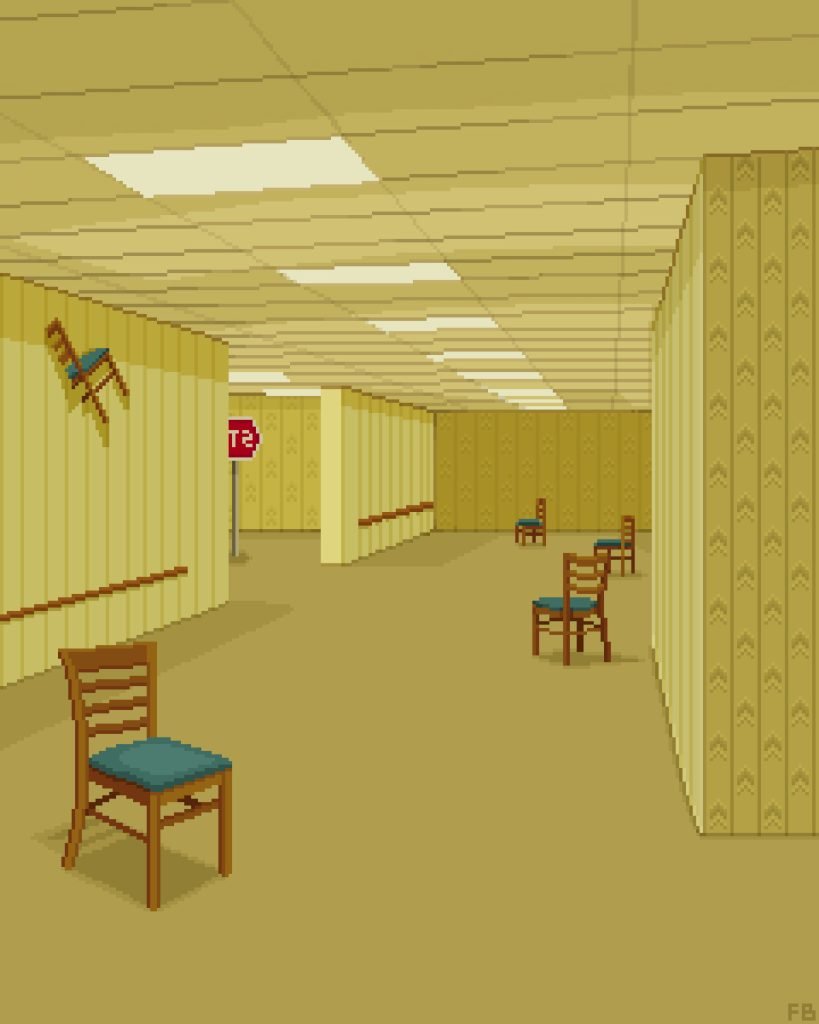
Have YouTube-era horrors Backrooms and Obsession taken us into a post-superhero era? Have the critics understood the shift: that horror is the realism of our time?
The words projected on the wall could not be clearer: fantasy and science-fiction movies with witty superheroes and gaudy icons of empowerment are a thing of the past. Masters of the Universe, Supergirl and Desert Warrior die at the box office, and the latest Star Wars film barely attracts the most diehard fans of the fatigued franchise. Are streaming and bingeing killing moviegoing? Are youngsters too busy vaping and doomscrolling to flock to films that they ought to be flocking to?
Filmgoers young and old have, in fact, been going to the movies this year, but not to salivate over ripped men in tights and glass-ceiling-shattering starlets. Bringing in around $350 million on a budget of $750,000, Obsession is the story of the horrific impasses of love in a world of mutually assured destruction of the sexes. As commercially successful, Backrooms is a hallucinatory journey in the minds of unremittingly unhappy, self-hating loners.
These lowkey horrors have generated much commentary. Variety claims that their ‘shocking success’ is forcing Hollywood into ‘thinking outside the box’. Which box might that be? The marketing-driven design-by-committee drivel of the aforementioned flops, no doubt. But let us note that both Obsession and Backrooms are released by two highly market-oriented, albeit ‘indie’ studios—Blumhouse and A24, respectively—and that the latter film drew on the vast popularity of a series of digital or creepypasta visuals that have long gone viral.
What is shocking is not that two movies with great festival buzz and online fandom, directed by two prolific YouTubers, have made a bunch of money. What fascinates is that these films, so unlike the previous ‘indie’ hits that have previously compelled Hollywood to ‘think outside the box’, are not goofy, quirky and, ultimately, feel-good. The Variety article states that the success of Backrooms has propelled its distributor into ‘its full Miramax era’. However, the films that made Miramax a cinematic game-changer in the 1990s and early 2000s, Pulp Fiction, Clerks and Amélie, are decidedly dreamy compared to the nightmares of Obsession and Backrooms.
The careers of these films’ young directors are unusual, but not exceptional. Much has been made of Obsession’s director Curry Baker coming to the attention of producers via his YouTube videos, or Backrooms’ director, Kane Parsons, being approached by film studios due to his online content. These rags-to-riches tales of talent-spotting are a mainstay of the mythology of the Dream Factory. Charlie Chaplin was a vaudeville performer, copping pies in the face before being discovered by the studios. Steven Spielberg, not unlike Baker and Parsons, came to the attention of producers thanks to his short films, including a made-for-television horror. Small-time success on the stage or the small screens of either television or the smartphone has led and continues to lead to success on the big screen.
Comparing young Baker and the even younger Parsons to Chaplin and Spielberg may prove premature. The last YouTuber wunderkind to be lured by Hollywood, the Swedish David Sandberg, was placed, sadly, at the helm of an inane superhero franchise, Shazam!, the second instalment of which bombed very hard. Baker and Curry could hang on to their auteur’s aura or trade it in for multimillion-dollar stints. Either way, theirs is not a unique professional story. What is interesting, even remarkable, is that their insanely successful films are intensely, unrepentantly bleak.
Obsession begins and ends in the house of a dead woman who casts a morbid shadow over her nephew, Baron ‘Bear’ Baily. Bear (Michael Johnston) moves into the dead woman’s house, only to find her cat also dead due to ingesting her owner’s oxycodone. Bear is surrounded by death and grief, and he certainly looks and acts the part. He is shy and morose, and has a crush on his coworker Nikki (Inde Navarrette). In a moment of desperation, he resorts to the gimmick of a novelty toy, a ‘One Wish Willow’. It’s a breakable twig that is supposed to grant the wish of the person who breaks it. Bear, needless to say, makes the wish to be loved by Nikki, snaps the piece of wood, and immediately receives what his heart so fervently desires.
This could easily be the premise for a romantic comedy, and Obsession is not devoid of laughs. But this comedy-horror does not delight its viewers with anything like Sam Raimi’s over-the-top zombies. Curry’s jokes are funny because, as Homer Simpson would have it, they are true, and painfully so. Obsession does what so few other films dare to do. It suggests that sexual ardour, either Bear’s secret affection for Nikki prior to the breaking of the magical willow or Nikki’s visceral attachment to Bear afterwards, is no laughing matter.
Love in this film does not promise bright enchantment amid the grim reality of life in a disenchanted world. Love becomes the grotesque negation of sexual difference. The man and the woman who wish to be loved can no longer depend on their mutual otherness to make love an event. They cannot use it for self-actualisation via an ethics of attentiveness to the other. Sexual intimacy in this film becomes a kill-zone of voracious, monstrous, murderous wish-fulfilment. In love, no one can hear you scream.
Backrooms is a more serious affair. Its protagonists, Clark (Chiwetel Ejiofor) and Mary (Renate Reinsve), ought to be plucky and optimistic. Clark owns a massive furniture store, and Mary is a successful, media-savvy psychotherapist. After a glitchy found-footage prelude that introduces us to an eerie maze of rooms and corridors with yellow wallpapers and low ceilings, we see Mary try to help Clark come to terms with the end of his marriage. It is immediately obvious that neither Mary nor Clark is up to the task. Mary is timid, anxious and herself very much in need of therapy, and Clark is too angry and too much of an alcoholic to take a calm, sober look at himself.
One cannot but be impressed by Parsons and his scriptwriter Will Soodik’s imaginative development of fragmentary online ephemera into a coherent, feature-length narrative. Clark and then Mary eventually find their way into the labyrinthine parallel universe of the title, where very sinister things await. There are some jump-scares and some intimations of a Lovecraftian realm of monsters beyond human comprehension. But the film’s most salient images are those of mental corrosion and madness. Clark encounters a horrific manifestation of his own self-loathing in the backrooms. Mary discovers that her own mind has been shaped by as much anguish as those of her most damaged clients.
It is certainly surprising to have young filmmakers who direct with assurance and panache. It should also be noted that the acting, sound and visual design in both films—particularly sound in Obsession and mise-en-scène in Backrooms—put more expensive films made by more experienced filmmakers to shame. But the huge cultural and commercial impact of this duo of YouTuber horrors cannot be reduced to their aesthetics. They have resonated so strongly with so many moviegoers not in spite of, but because of their downright grim perspectives on contemporary life.
I’m not suggesting that everyone who has seen either of these films shares their perspectives on love and the mind, or that people in general seek a validation of their views in films and works of art. That the fears and failures of the protagonists of Obsession and Backrooms are much more believable than the preposterous superheroics of He-Man and Supergirl seems obvious. What is more significant is that in both Obsession and Backrooms we have cultural depictions of difficult things that we very rarely see in contemporary—including arthouse—cinema today.
Bear’s terror of rejection by women and Nikki’s addictive dependence on men in Obsession; and Clark’s and Mary’s inability to leave the labyrinths of the eternal recurrence of trauma in Backrooms; these are compelling motifs not to be found amid the up-to-the-minute cultural references and zany product placements of anodyne blockbusters. Which suggests that the great Kim Stanley Robinson was wrong. It is not science-fiction that is the realism of our time. It is horror. These films have the courage to show us as we appear to ourselves. Not as admirable, super-fit, jokey, wealthy, wily supermodels, but as alienated, melancholic men and women who fear the other because they fear themselves; who are desperate for love and come to love their desperation; who struggle to find hope and healing in a mental landscape of hurt and self-loathing.