


Deborah Adelaide, When I Am Sixty-Four, UQP, 2026
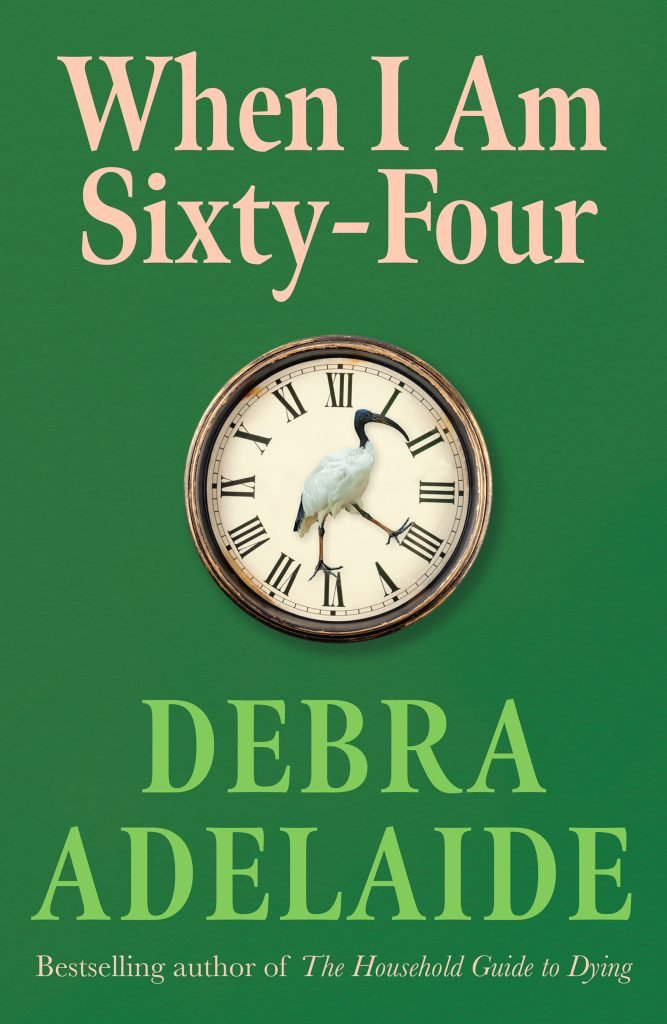
Gabrielle Carey was a writer, scholar, fine reader, interpreter of James Joyce, adventurer, writing teacher and mother. When I Am Sixty-Four, by her friend Debra Adelaide, is a book about a long and complex friendship between the two authors—and two readers and two university teachers of writing. It focuses on the last period of Adelaide’s friendship with Carey before she died by suicide, on her sixty-fourth birthday. Interwoven into the details of the author’s attempts to keep the other author engaged with life is another history of their vivid lives intersecting over decades. In the final pages, Debra Adelaide tells us that this is a work of autofiction. Autofiction as a literary device both reveals and conceals. That it comprises fictional and non-fictional elements places the reader and the reviewer on shaky ground, which is precisely the point. There is the historical Gabrielle Carey, the subject of the book, not named but with many actual details included about her life and her writing, and then there is ‘my friend’, a character in a supposed novelistic memoir.
Incomprehension and anger always accompany those confronting a loss by suicide. In this respect, one can see the choice of the genre of autofiction less as a literary choice and more as a way of using the cloak of fiction, a way of protecting Carey’s loved ones and ensuring the anonymity of others. It is also a loving gesture by Adelaide, who does not want her friend to be defined by the manner of her death. Yet this caution comes at a cost. The terms ‘mental illness’ or ‘depression’ used in the book and elsewhere about Carey simply fail to capture the ferocity of the death drive at work in her suffering. Adelaide deftly registers this abyss in different ways. However, through the small and sometimes domestic details she recounts: her friend leaving the food left for her unheated and uneaten; Carey trying to divest herself of possessions; her delusion of impoverishment; her sense that she had or was nothing; and her amnesia. This disappearance of key parts of their shared history felt particularly acute for Adelaide. In more than one incident, her friend fails to recall experiences, moments or stories from their past. The narrator tries to prompt her friend, saying remember, we used to ‘laugh about [it] all the time’.
But no, she still did not remember,
And so not only were our opportunities to laugh together stolen, at this time when she was suffering, but also our shared memories.
Gabrielle Carey was also famous, of course, as co-author of the teen confessional Puberty Blues, with Kathy Lette, published in 1979. Carey did not want this co-authored book to be her legacy and spent much of her life trying to escape from being associated with it. I am also reluctant to refer to it. However, dyadic relationships play a structural role in Adelaide’s narrative, so it is important to acknowledge this dyad as one of the three in the book. Lacan would call these semblables, counterparts, a type of double, where a subject recognises themselves in an other and identifies with them as a loved object or as a rival (one they may wish to destroy) or both.
Significantly, the narrator does not name Lette. Lette appears briefly as a spectral presence, called ‘the other friend’. Her class background is contrasted with that of Adelaide, and it is implied that the resumption of the friendship between Carey and Adelaide when they re-meet as new mothers is predicated on ‘the other friend’ not being in the picture. Lette’s trajectory is well known, including her celebrity writer’s status, her famed parties, her representations of her dazzling life and her endless puns. Carey’s path is less widely recognised. She retreated from public view after the huge success of the 1981 film of the book. Moving away from this particular limelight involved unconventional choices that incorporated varying levels of discomfort, repudiation and questioning, such as marrying a former prison inmate, a stint in a Benedictine Monastery in Ireland and living in poverty with a new baby in a Mexican village. She also stepped away from writing fiction altogether. Her sharp prose became reserved for non-fiction: autobiography, biography, essays, memoir and articles for literary journals and newspapers.
The other dyad here is that of Gabrielle and her father, Alex Carey, a prominent and energetic social psychologist, author, anti-war activist and lecturer, a man praised by Noam Chomsky, who dedicated Manufacturing Consent to him, for his hugely influential work on corporate propaganda. Alex Carey took his own life on the day he turned sixty-four.
The lethal repetition of this by his daughter on her own sixty-fourth birthday could be viewed through the lens of an unprocessed loss. Perhaps it is safer to speak about the ‘friend’ in Adelaide’s book rather than ‘Gabrielle Carey’ at this point. In the ‘my friend’ character, it is possible to see an overwhelming unconscious identification with a lost object, where the work of letting the dead go had been, for whatever reason, impossible for her. The psychoanalyst Darian Leader analyses many examples of the link between dates, anniversaries, bodily symptoms and suicide. Nikolai Gogol’s father died at forty-three, when Gogol was sixteen years old. He committed suicide by starvation when he reached the same age as his father. In The New Black, Leader also discusses others, such as Vincent van Gogh and his identification with the number twenty-nine carved on a gravestone of a sibling who predeceased him. He took his life on July twenty-nine, the same date. While suicide is an uncommon form of death, Leader argues that such identifications and what he calls the emergence of ‘anniversary symptoms’ are common, noting their prevalence in GP records.
The number sixty-four functioned as a privileged marker for Carey. It represented a particular form of timekeeping. While she wrote candidly about her fears around it, unconscious identifications did not seem to be unearthed. Adelaide references a conscious memory in the title she chose for this novel. It concerns a memory of her friend/Carey sitting on her father’s knee in one of his rare times at home with family. Father and daughter sing the jaunty Beatles’ song together in a moment of harmony.
This book portrays loss with great insight. Adelaide’s account of her friendship with Carey has been acclaimed as ‘a homage’, ‘a jewel’ and a ‘masterwork’. Yet to me, such affirming terms fail to capture the grim struggle at the heart of this book. The gravity, ethical dilemmas, and the necessity of documenting her friend’s slow disappearance from life and her own creative, loving but futile attempts to ensure that her friend did not die, sit alongside an attempt to honour the manifold elements of a long history of friendship around reading and writing. Embedded in the various musings, the narrator grapples with guilt, retrospective searches for clues, self-reproaches, fantasies of ‘if-only’, grief and anger. For those of us who loved the writing of Gabrielle Carey but did not know her personally, her death remains a significant loss, and this memoir is a record that it cannot be assuaged.