


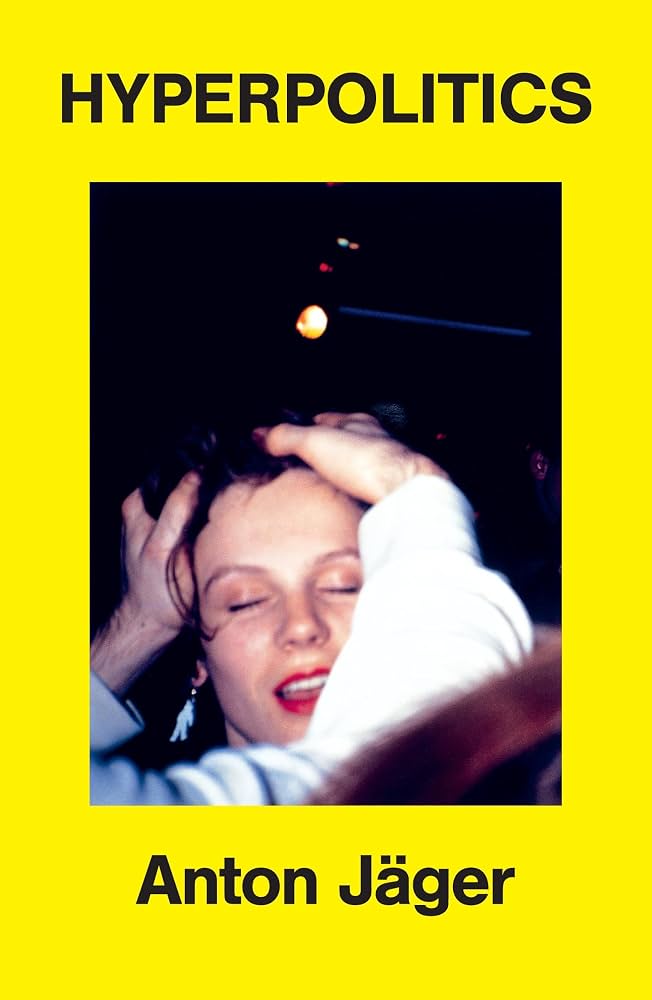
Anton Jäger, Hyperpolitics: Extreme Politicization without Political Consequences, Verso, 2026
Recently, I’ve become friendly with a futurologist, who assures me that, contrary to Zizekian wisecracks to the effect that it is easier to imagine the end of the world than it is to imagine the end of capitalism, most people are actually very good at conjuring up alternative systems. What they lack, she tells me, is any faith that their actions can bring those systems into being, or even bring them a little closer. At the level of practical politics, this might sound like a distinction without a difference: if your just society is impossible to realise, it is simply a bit of ‘social poetry’ to throw the present into an interesting new light. But at another level, it may well speak to a deep disjuncture in the modern moment: a disjuncture between how political we feel and how able we are to effect political change.
For the Belgian historian Anton Jäger, we are indeed living through such a disjuncture. In his new book Hyperpolitics—a big hit with the Left and liberal progressives—he suggests that the broiling political tensions that characterise contemporary politics are now fundamentally disconnected from the systems and processes of political change. Oppositional politics in particular are increasingly subject to ‘short-term logics’, their ranks ‘animated by brief, potent stimuli, stirred to action by charismatic influencers and digital demagogues’. Movements such as Black Lives Matter, the Gilet Jaunes and the Climate Strikes disappear as quickly as they come into being. Perhaps channelling Deleuze and Guattari’s notion of a ‘body without organs’ (corps sans organes), Jäger employs a Carrollian metaphor to describe this dynamic, or lack of a dynamic: it is, he writes, like a ‘grin without a cat’.
For Jäger, the disjuncture of modern politics is essentially a structural question: it is the fact that those entering the political arena are no longer grounded in abiding institutions that ensures their political impotence. We live in a time of political turmoil, and yet the civic membership and associational density that characterised the era of mass politics remain at levels more akin to the ‘post-political’ 1990s. The class solidarity that once gave life to the union movement and its political proxies has been undermined by neoliberalism, resulting in oppositional politics becoming a kind of shadow play—a thin imitation of the protest movements that characterised an earlier era. Lacking the organisational ground that delivered progress in the ‘short twentieth century’, such movements remain irrevocably bogged, spinning their wheels in a muddy paddock of socioeconomic resentment.
To distinguish his central concept, Jäger delineates four eras of politics, beginning in the early twentieth century and taking us up to the current moment. He posits a Cartesian plane with two axes: a vertical axis corresponding to the amount of political agitation in evidence; and a horizontal axis corresponding to the level of (civic and political) institutional activity. The era of ‘mass politics’ (roughly 1914 to 1989) is marked by high levels of politicisation and high levels of institutionalisation in the form of union membership, congregations, working men’s clubs and so on, and is associated with concrete gains such as increasing pay and better conditions, social housing and the welfare state. By contrast, the era of ‘post-politics’ (1989 to 2008) is marked by low levels of politicisation and institutional affiliation—by Fukuyama’s end-of-history thesis and neoliberal technocracy—while the era of ‘anti-politics’ (2008 to the early 2020s) is marked by the return of politicisation in the form of the protests in North Africa and the Middle East and the populist wave in the US and Europe, culminating in the political victories of Trump and Brexit in 2016. The final era is hyperpolitics, marked by high levels of politicisation and low levels of institutionalisation. In terms of Jäger’s Cartesian plane, hyperpolitics thus describes a ‘K-shaped recovery’.
Though Jäger’s taxonomy helps us to periodise politics over the last century or so, his analysis more broadly lacks explanatory power. Clearly, he is right to identify the era of post-politics as one in which working-class solidarity was violently and determinedly undermined, and the state restructured along neoliberal lines, and right too to suggest that liberal thinkers such as Robert Putnam (Bowling Alone) reproduced the ethos of neoliberalism while purporting to push back against it—in Putnam’s case by linking concerns around civic and political engagement to the Tocquevillian concept of ‘social capital’. But if Putnam and his analogues proved insufficiently self-aware, Jäger himself is too steeped in old habits of (largely Marxist) thought to steer us aright. In particular, he is wedded to a base-superstructure model that reduces the current political moment to a chapter in the same class war that characterised the era of mass politics. ‘The primary forms of political engagement are as fleeting as market transactions’, he writes, in one of a number of passages that link (or reduce) the political landscape to the atomising effects of capital. As for contemporary politics itself—its dividing lines and shibboleths—Jäger has precious little to say; its chaotic and ephemeral character is enough to establish it as the discursive projection of a materially atomised society. Nor does the vulgar Marxism stop there. At one point, Jäger cites Wolfgang Abendroth’s contention that it is not enough to reject nuclear weapons; one must reject them from the correct ‘class standpoint’ and situate their development within the broader context of the history of the working class. To call this self-satirising would be to put it mildly.
By framing hyperpolitics as a ‘market-friendly’ phenomenon and declining to look in any detail at the content of political contestation in the third decade of the twenty-first century, or indeed the ways in which that contest is reflected in changes ‘on the ground’, Jäger makes the same mistake as many, broadly Marxist, thinkers—one neatly described by Marx himself in The Eighteenth Brumaire of Louis Bonaparte as trying to learn a new language by translating it into one’s native tongue. The modern Left is simply assumed to be the champion of the working class, and the Right the defenders (objectively speaking) of the neoliberal status quo. Jäger does not consider the possibility that the Right in its populist manifestations may in fact be nostalgic for the social solidarity whose lack has done for the labour movement, or indeed that the Left, with its strident stances on abstract rights and radical openness, may in some sense be the agent of atomisation, not its natural enemy. The social relations emerging from, or catalysed by, the neoliberal era, when a newly expanded ‘knowledge class’ came to the centre of economic life as a consequence of deindustrialisation, and the effect of those new social relations on the politics of the last quarter century, are barely discussed in Jäger’s book. But surely one cannot understand the current moment, hyperpolitical or otherwise, or the fact that reactionary populism has won out over its Leftist iterations, without attending to the great divide now running through advanced economies—between a ‘professional-managerial’ cohort in thrall to an abstract progressivism, and an increasingly excluded and marginalised mass, resentful at what it sees as an alien system.
The irony of this lacuna is that these new social relations, or newly prominent social relations, derive partly from the abstracting effects of communication technologies, fresh varieties of which have catalysed Jäger’s hyperpolitical moment. In a deep sense, the professional-managerial class is the representative of the ‘intellectual practices’ that came into being with the invention of printing, and its social and economic centrality means that knowledge and information themselves are now political quantities, their dissemination in the cause of progress, growth, efficiency, productivity and so on an implicit rebuke to those whose abilities—whose manual competence or upper body strength—once ensured their socioeconomic prominence. Jäger characterises the internet and social media as aggravating factors within hyperpolitics, and he’s right to suggest that there is something in those technologies that is antithetical to the building of consensus, reasoned debate and enduring solidarity. But what he overlooks is the fact that the Left, as an entity drawn largely from the knowledge class, now regards the manipulation of knowledge and information as a political act, in a way that is historically novel. If Jäger’s hyperpolitical era is one in which we witness a disjuncture between discursive politics and material change, it is partly because the discursive has become, for many on the Left, the stuff of politics. Indeed, it is now impossible to distinguish between (material) class war on the one hand and the (discursive) culture war on the other, given that the creation of culture is so central to economic life. A properly materialist account of the current moment would attend to the ways in which political subjectivities have been transformed by such deep-cultural changes and new communication technologies.
That Jäger himself is in part a product of what we might call the ‘informational turn’ is revealed in his rather strange approach to the subject of hyperpolitics—an approach that is split between a simplistic materialism and a more academic ‘culturalist’ perspective. On the face of it, Jäger’s political worldview is the one encountered in Jacobin and its equivalents: it assumes a working (or subject) class whose interests are fundamentally at odds with capitalism and the owner class, and takes this as the central fact of political economy. But at regular intervals in the book, Jäger turns to ‘cultural objects’ that throw new light on the political ensemble under discussion at any one time. The photographs of Wolfgang Tillman, whose work is taken to be reflective of the ‘cultural amnesia’ of the 1990s, and the novelist Michel Houellebecq—‘the emblematic novelist of the post-political era’ and barometer of the more reactionary currents to emerge in the years after the global debt crisis—are two figures of particular interest, and Jäger has some interesting thoughts on both. But they make for a rather incongruous addition to what is in essence a heavily structural and stolidly panoramic analysis. Jean Baudrillard is there in the title, of course, and pops up at various points in the text, like the postmodern ghost at the Jacobin feast. But why defer to the very philosopher whose contribution was to take the grin for the cat?
‘Atomisation and acceleration go hand in hand’, writes Jäger in his opening chapter; ‘people are lonelier in the new century, but also more agitated; more atomised, but also more connected; angrier, yet more disoriented’. All true. But a materialist account of this reality that remains wedded to the old assumptions in the face of so much that is radically new is an account that is sure to lead us astray. The Left’s materialism needs to go deeper, even to the point of giving its own origins a rigorous social and historical account. Indeed, to keep falling short in this way is to dishonour the memory of the two German cats who kicked this whole materialism thing off, and whose version of the just society was a projection of their own immersion in intellectual practices, and never likely to be realised.