


A tour of the clearing zones, being sacrificed for agribusiness and a burning planet, contested with resistance and regeneration
Squinting out of the hire car window into the bright light of southern Queensland’s winter sunshine, we are able to read the vivid yellow warning sign affixed a little unevenly to the bottom corner of a wire gate that is padlocked closed at the front of a driveway:
Is There Life After
DEATH?
JUMP THIS FENCE
AND FIND OUT!!!
I’m travelling in a nondescript hire vehicle with three members of a Greenpeace campaign team. There’s a camera mounted on the fence, angled outwards in a rigid pose that is suggestive of palpable suspicion, and we speculate that a car full of meddling environmentalists might well be of interest to whoever is at the viewing end of the apparatus.
On this day, though, our mission is not focused on whatever lies beyond the gateway, so we don’t need to test the prospects of eternal salvation. Instead, our interest lies a little further up the road, where, a few minutes later, we pull up alongside another waiting car. Introductions follow. Among those we meet is Dr Martin Taylor, an expert on deforestation in Queensland, who has identified the fields that we’ll be examining as being of interest by analysing land use change via satellite imaging.
Beyond the low barbed-wire fence that separates the public road reserve from the private leasehold land, a hard, bare paddock stretches out in front of us. The grass cover is scarce and mean, punctuated by the occasional cow-pat. There are one or two trees here and there, and sporadically, some low dark mounds of charred remnants.
‘This was cleared around twelve months ago’, Martin explains, and later he shows us the satellite images that prove the dates. ‘You can see from the treeline, what it used to be like’. He hands me the binoculars and I study what looks like some dense bush at the rear of the denuded land, at what I would guess is a distance of about 400 metres. ‘That’s about thirty years’ worth of regenerating forest’, Martin says dryly, ‘and that is what was bulldozed…ideal habitat for koalas’. As I stare, a flock of maybe a dozen birds, little more than winking dots at this range, rises from the forest and careens away.
A short time later, one of my fellow Greenpeacers, a qualified drone operator, launches a unit into the sky to obtain some aerial footage. Seen through the machine’s unfeeling eye on the control screen, the land is drab, the pasture appearing even poorer from above. The undulating land has been scourged by dozens of vehicle tracks, and the sites where the smashed-up forest was burned stand out like malignant moles on sun-scarred skin. The brutalised topography is reminiscent of the blurred pictures of no man’s land taken from biplanes in the later stages of the Great War: a vision of exterminatory intent made manifest in the pitiless churning of the earth.
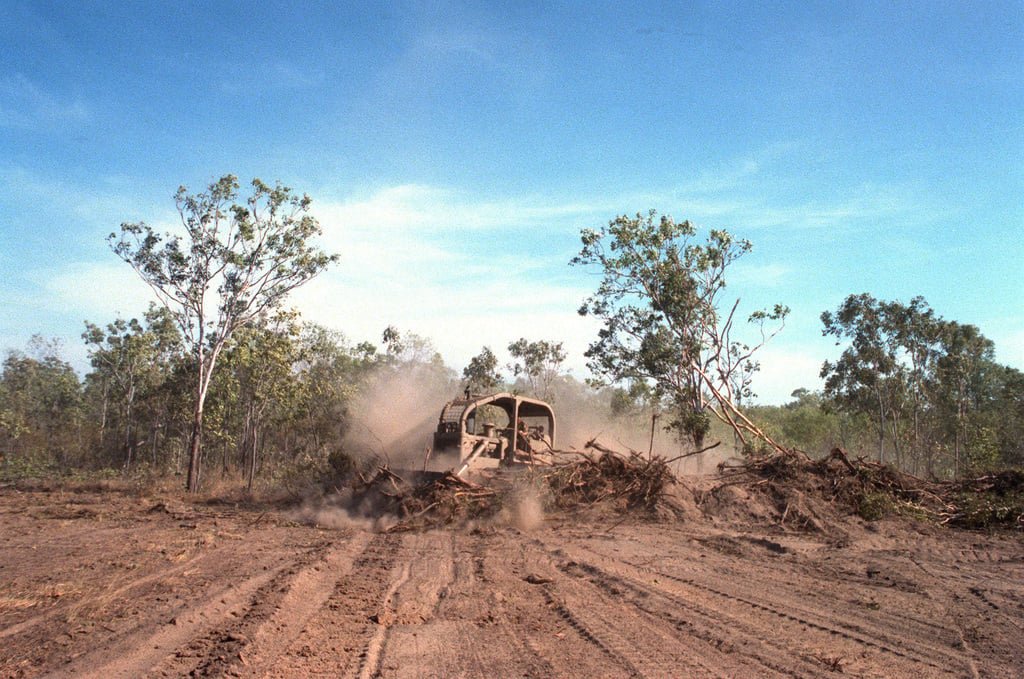
In short order, we visit another site that has been cleared so recently that the smoulder is still rising from the pyres of what not very long ago was a thriving mass of living things. The bulldozer that was responsible for the clearing remains nearby, driverless now, and silent. The shape of the great yellow destroyer evokes a sleeping monster with its appetite now slaked, the mechanically muscled body slouched and supine. The machine’s unmoving blade resembles a great concave lip curving above the cutting teeth of a massive inhuman grin.
A couple of hours later we are gathered in the back of a friendly roadside diner. Nestled in a small row of shops whose continued existence has so far defied the conquering banality of franchises and big box stores, the homely establishment seems largely untouched by latter-day trends of nouvelle cuisine. I’m leaning against stacked cans of a beverage called KAMIKAZE ENERGY as we look at the geospatial data compiled by Martin, and try to make sense of the devastation that we’ve just witnessed and documented.
Once an expert in ecological toxicology at the University of Arizona, Martin first got involved in environmental protection in that context, but for many years now has been tracking and speaking out about deforestation in Queensland with dedication and rigour. He is also extremely generous with his work, and I am conscious that years of labour have gone into the maps and spreadsheets that he is now sharing with our group.
Australia is the only developed country in the world to have been identified as a global deforestation front in the World Wildlife Fund’s landmark 2021 global report. Although it is the vandalistic logging of the spectacular and iconic old-growth forests of Tasmania, Victoria and Western Australia which has, not unreasonably, held national attention, the majority of forest destruction today takes place in Queensland. A significant amount of what is being cleared is regenerating forest, often thriving, with a canopy that is between fifteen and thirty years of age and vital for recovering biodiversity, the climate, and the health of the country. Martin and one of my Greenpeace colleagues, forests campaigner Gemma Plesman, go through the bleak statistics as we make our way through a procession of coffee, fizzy drinks, pies and sangers. Between 2016 and 2021, more than 2 million hectares of recognised endangered species habitat were cleared—an area greater than the whole landmass of Jamaica. Coincidentally, a day or so later the statistics for 2021–22 become available, revealing that another 323,676 hectares of forest and bushland have gone—an area almost five times the size of Singapore—in a single twelve-month period.
Overwhelmingly, deforestation in Queensland is taking place on historical pastoral leases—often very large scale holdings that enabled the holders of title to exploit the land for development and gain—that are now freehold land. The extent of the rights that exist under such leasehold was given high profile consideration by the High Court of Australia, in the Wik case in 1995. In the event, the decision of the majority was that the native title of the Wik and Thaayorre Peoples had not been extinguished by the grant or use of the tenure, with counsel successfully contending that the task of the court was simply to read the terms of the instruments in question, rather than to accept the implied discursive assumptions of the colonisers. Nonetheless, the litigation and associated political hullabaloo highlighted the extent to which pastoral lessees are able to exploit the country in question with comparatively little restraint. Deforestation in Queensland is thus both continuation and echo of the original dispossession.
The explanation of what is happening in Queensland has a familiar feel: institutions and laws largely set in place in the nineteenth century to enable capitalist, colonialist exploitation led to the establishment of ongoing rights that have never been adequately reformed, and so continue to be available as a basis for vested interests to devastate country in search of profit. And so it is that despite the clarity with which it is now evident that the ideals underpinning land use laws are as retrograde and unfit for purpose as emptying buckets of human shit into the street from our doors and windows, these structures persist, undergirded and propelled onward by the forces of capital accumulation and political power that they established and continue to permit and legitimate.
Particularly relevant is a loophole in the state’s vegetation management laws which makes large areas of land that have previously been cleared, exempt from government management under the ominous designation of ‘Category X’, even though the forest may have regenerated to a healthy state and be habitat to threatened species. Subdivisions for housing within Queensland’s urban centres require careful attention to impact on native flora and fauna, with experts being required to attend to the removal of creatures. Not so where deforestation takes place on ‘Category X’ land within the pastoral lease estate, which can occur without any state or federal government controls.
Sometimes the trees are simply bulldozed, as in the paddocks that we’d surveyed earlier in the day. There’s an even larger scale way of doing things, though, which involves dragging a heavy-duty chain between two earth-movers working in concert, effectively pulling down everything in between like a mass garrotting. It has proven difficult to get film of this practice in operation, but in 2014 the Wilderness Society were successful in capturing extensive aerial footage of land clearing from a property near Laura, Queensland that is still available for viewing on social media. The confronting vision puzzles the eye at first, as trees seem to be spontaneously shuddering and collapsing, as if they are fainting in apprehension at the coming of the machines. At second look, though, the mechanics of the method become clear and you can make out the line of the chain, cleansing the land of the unwanted wildlife of trees and creatures that have grown up in its way, wiping them away like unwanted detritus from a table-top. With the strength of root and branch, each tree resists, but one after another, all are brought down.
The majority of the deforestation that is occurring in Queensland is done to make the land available as pasturage for cattle. So, for example, between 2015 and 2019, more than 73 per cent of deforestation was for beef production. These cows are then slaughtered at abattoirs in Australia, with the meat products largely headed for domestic sale by well-known front-facing retail brands. So it is that the regenerating forests of Queensland are being demolished and burned to graze the cattle that end up in burgers at the likes of McDonalds and Hungry Jacks, and in the beef products of supermarkets including Coles and Woolworths. It is country being sold so cheap. Maccas and Hungry’s might not actually market ‘koala burgers’, but the causation is as clear as if the Big Macs and Whoppers featured native animals among their key ingredients.
The anaesthetised koala is helpless and pathetic on the operating table, blood plainly visible from one swollen eye socket
One day after the trip to document the deforestation, we visit the RSPCA animal hospital in Wacol, which treats more injured and sick native creatures than any other facility in Australia. Our friendly and courteous guide and host is Dr Tim Portas, who is the facility’s head veterinarian. He’s a tall bloke, whose expressive wringing hands seem to convey something of the weight of his role, deciding on clinical priorities, including which animals are able to be saved and those which are beyond any hope of humane intervention. Patiently, Tim takes us through the complex, showing us recovering koalas, a tortoise, some flying foxes, various birds, possums and other creatures—all among the current patients—including the pitiable prone koala that we see in triage. Wacol treats somewhere between 24,000 and 28,000 animals per year, with a save rate of around 35 per cent, and you feel a swell of uncomplicated gratitude for the dedicated staff and volunteers who do their absolute best to care for and heal the stricken animals that are brought to them. Road strikes and dog attacks are among the commonest sources of injury, yet the number of these individualised incidents is on an altogether different scale to the animal mortality that is the consequence of land clearing.
It is unfair, but undeniable, that humans see species of animals differently for entirely anthropomorphic reasons—not that creaturely fame among humans is any guarantee of avoiding extinction, as any Tasmanian Tiger could testify. Koalas are a big reason why some people visit Australia, but this star of the celebrity animal firmament is in trouble. In February 2022, the combined koala populations in Queensland, New South Wales and the ACT were listed as ‘endangered’ under the Commonwealth Environment Protection and Biodiversity Conservation Act. Reflecting on this, quite suddenly, Tim tells us that he is worrying that he is fighting slow defeat, and that the koala could become extinct in southern Queensland in his lifetime.
According to one estimate there are as few as 17,000 koalas left in south-east Queensland. Roughly 1400 are treated at Wacol every year, of which around a third are able to be saved and then re-released back into the wild. If the koala’s home habitat has been bulldozed, then the creature will be translocated to a prospective new home. But as we hear from Tim, koalas are fussy buggers, with not only very restrictive diets but idiosyncratic individual tastes—and an animal that cannot get the eucalyptus leaves that it wants will simply starve to death.
A week or so after our trip to Queensland, Greenpeace and the RSPCA published a joint report containing the most up-to-date estimates of animal mortality from land clearing in Queensland and northern New South Wales. The headline figure is truly staggering. The scientists estimate that more than 100 million vertebrates are killed, injured or displaced by deforestation in the geographies in question every year. Those that do not die immediately face a very uncertain future as potential new habitats diminish.
And for wildlife as for humanity, conditions are becoming rapidly harsher under the general threat magnifier of climate change, of which deforestation is a major driver. While reliable statistics on climate pollution from deforestation in Australia are frustratingly elusive, the quantum is unquestionably significant, with estimates ranging from 6 to 20 per cent of the nation’s annual domestic emissions. Apart from driving biodiversity loss and climate change, deforestation also causes rising salinity, soil erosion and damage to the water table—a lose-lose-lose-lose scenario.
In a world of complex problems, solving this one should be simple
Deforestation in Queensland occurs on individual properties, driven by hundreds of small and large businesses raising cattle, but as always, the causation that really matters is at the systems level. Policies and controls required by Australian processors and retailers could readily ensure that value chains are deforestation-free. Through the weight of purchasing power, major companies could send unambiguous market signals that beef that is not conversion- and deforestation-free (meaning no destruction of all natural ecosystems) will have no place in their operations by 2025. The significance of this formulation and target date would be to bring Australia into line with major global initiatives such as the Science-Based Target Initiative (SBTi) and Science-Based Targets for Nature (SBTN), as well as incoming EU import laws.
Such a transformation in business procurement would also foster conditions of political economy that are conducive to creating a permanent change in law and the governance of Queensland’s forests. There’s a further confluence of strategic factors that is conducive to decisive change: the Albanese government’s need for levers to pull to reduce emissions and need to build momentum towards the likely Australian-Pacific hosted UN Climate Conference COP 31 in 2026; its commitment to the Glasgow Leaders’ Declaration on Forests; and the widespread recognition that land clearing must be a key priority of the hopefully-soon-to-be established national environmental protection agency.
It is not too late for redemption for Queensland’s remaining regenerating forests, and there is confidence that with sufficient public pressure, the corporations that are ultimately responsible for the destruction of the mass of Queensland’s regenerating flora and fauna via deforestation will move. Not long after our site visit, Woolworths made a decisive move by committing to be deforestation-free by 2025. The supermarkets are copping plenty of shit at the moment, but credit where it is due and this is an excellent move by Woolies. With Aldi already having made the same pledge, Coles has now become isolated as Australia’s only major supermarket without a strong deforestation-free policy.
As big business begins to change course, it is becoming evident that legal and regulatory requirements requiring deforestation to be eliminated from corporate supply chains would not only be accepted, but perhaps even welcome, as a competition-neutral measure to neutralise a growing reputational risk. It is important not to overstate the point—Maccas is not going to become an eco-cooperative any time soon—but nonetheless, the wider lesson of a successful campaign to change land management in Queensland should be structural: namely, that the operation of capital must be subject to both democracy and ecology.
In a heating world of polycrisis, there is something especially hopeful about the materiality of Queensland’s real and existing regenerating forests. The growing trees wave like pennants of defiance, reminding us that life will always fight for life, regardless of the odds. In nature, there is an afterlife of sorts, so long as ecosystems are given the chance to resurge. Nothing is certain in the politics of environment and land use in Australia, but halting deforestation for beef in this country is eminently possible in short order, and in these urgent days the chance and the moment must be taken. Behind the fences of Queensland’s pastoral estate, the razing of regenerating forests can be ended for good, so that the trees, and the millions of animals that inhabit them can grow and flourish.
Note: McDonald’s has now also committed to becoming deforestation-free and to addressing the conversion of natural ecosystems by 2030—an improvement, but still further down the track than the science-backed 2025 cut-off date